
Birds of the Sunlit Garden
One mark of the wisdom that belongs to a genuine culture is a constant awareness of the symbolic meaning expressed in every particular event — a sense of the universal within the concrete. This awareness lends dignity to any everyday activity, and it prepares the ground on which art rests and grows.
For all its great ethical, cultural and spiritual worth, this paradigm is of little use to the working photographer because of its unconstructiveness: it gives no answer at all to the question — "and how exactly is one to notice this symbolic dimension?" And although cultivating the soul does raise the chances of spiritual creativity, in practice it most often happens beyond the photographer's conscious will.
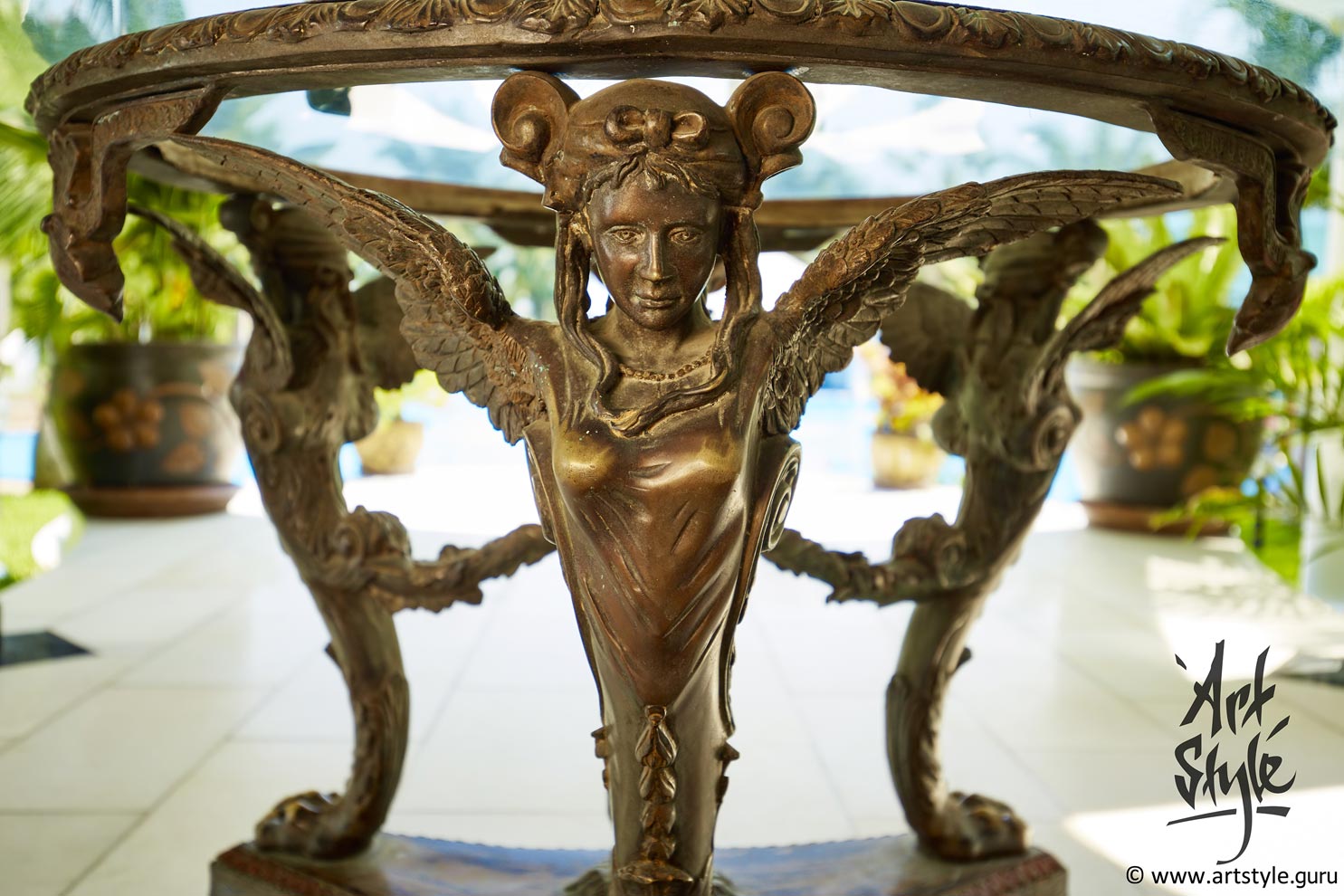
That is just what happened to me the last time: during an ordinary shoot of a luxury property, my attention was caught by a very strange table, sharply out of keeping with the rest of the villa's furnishings. When I asked about it, the owner of the villa said the piece had been left behind by the previous owners. I photographed the table the way I saw it — or rather, the way I felt it. And only while going through the work did I realize WHAT I had photographed. Such is a photographer's karma...
So — meet them: the central figure of this composition is the canonical image of the bird Sirin. Today it appears exclusively in Russian art, and it has been there almost since the very birth of the Russian metaculture, its roots reaching back into the now-forgotten imagery of the art of the East. In medieval Russian legends Sirin is unambiguously held to be a bird of paradise that now and then flies down to earth and sings prophetic songs of the bliss to come. But the spiritual world is not meant for those who live in the physical one — and so these songs can at times prove harmful to a person (one may lose one's mind). Sirin has at times been associated with the lilac (violet) color, which I have long considered the color of my own soul…
The most widespread legend also gave the magical birds their epithets: Sirin is the bird of sorrow, Alkonost the bird of joy. According to the best-known folk tale, on the morning of the Apple Feast of the Savior the bird Sirin flies into the apple orchard, grieving and weeping. And after midday the bird Alkonost flies into the orchard, rejoicing and laughing. The bird brushes the living dew from its wings, the fruit is transfigured and a wondrous power enters it — from that moment every apple on the trees becomes healing.
The name of the third bird is better known. It is the prophetic bird Gamayun (essay in Russian), messenger of the gods, their herald.
Together these birds embody yet another expression of the esoteric Rule of Threes: "All that exists reflects within itself the trinity of its Creator." It may be the past (Sirin), the present (Alkonost) and the future (Gamayun). It may be the spirit (Gamayun), the soul (Sirin) and the body (Alkonost). Or: birth — Brahma, Gamayun; life — Vishnu, Alkonost; and, most revered of all, death — Shiva, Sirin…
How did this huge, bulky table end up in Thailand? I don't know. And why was it Sirin in particular that I saw? It's quite simple — the summer of my life is all but over… But that is not frightening, only a little sad. For what lies ahead is the harvest of spiritual experience…