
Bestiary: parrots, pigeons & the jewel-coloured
The brightest, most flamboyant birds of the bestiary have gathered here together: bossy parrots, pigeons that look as if they'd been dipped in a paint pot, and creatures so jewel-bright you can't help suspecting a hoax. The name and the camera settings are under each frame; the characters, as always, speak for themselves.

Eclectus Parrot, female
Canon EOS 5D Mark III + EF 100-400/4.5-5.6 L IS II · 400 mm · f/5.6 · 1/50 s · ISO 2500
The eclectus is unusual among parrots for its extreme sexual dimorphism: the male is almost entirely emerald green, the female a vivid red with blue and violet. And, like many a domineering lady among Homo sapiens, the females keep the males in something close to slavery (sexual, by all appearances): the male spends nearly all his time foraging — first for the female, then for the chicks. He isn't allowed into the nest hollow, though: she takes what he's brought and parcels out the food to the young herself.

Red-breasted Parakeet, female
Canon EOS 7D Mark II + EF 100-400/4.5-5.6 L IS II · 400 mm · f/5.6 · 1/125 s · ISO 800
Red-breasted parakeets observe the democratic principles of gender equality to the letter: first, the females sport distinct “moustaches,” and second, the young males are visually indistinguishable from adult females. In other respects they're typical parrots — extremely loud and screechy.

Red-headed Lovebird, female
Canon EOS 5D Mark III + EF 70-200/2.8 L IS II + 1.4 ext III · 280 mm · f/4 · 1/50 s · ISO 640
I noticed long ago that many tourists, after their first few days in Thailand, turn exactly the colour of this lovebird's face. Scientists still argue over the cause: whether it's the sun to blame, or the holiday doses of alcohol.

Nicobar Pigeon
Canon EOS 5D Mark III + EF 100-400/4.5-5.6 L IS II + 1.4 ext III · 420 mm · f/7.1 · 1/80 s · ISO 1250
A large pigeon, around 40 cm long — the only living member of the genus Caloenas and the closest living relative of the extinct dodo. The female “builds” the nest: the male brings her twigs and she lays them out as she sees fit — with her own body serving as the nest's frame. These pigeons breed dreadfully, even by pigeon standards, and no wonder: there's just one egg in the clutch — and even that one is the female's doing.

Pink-necked Green Pigeon, female
Canon EOS 5D Mark III + EF 100-400/4.5-5.6 L IS II + 1.4 ext III · 560 mm · f/8 · 1/100 s · ISO 2500
No, this isn't your common pigeon that fell into a jar of aniline dyes, but a separate species coloured just so by nature. And although it eats in a way that would put a pig to shame — swallowing fruit whole and regurgitating the stones afterward — by the canons of Judaism it counts as a kosher bird.
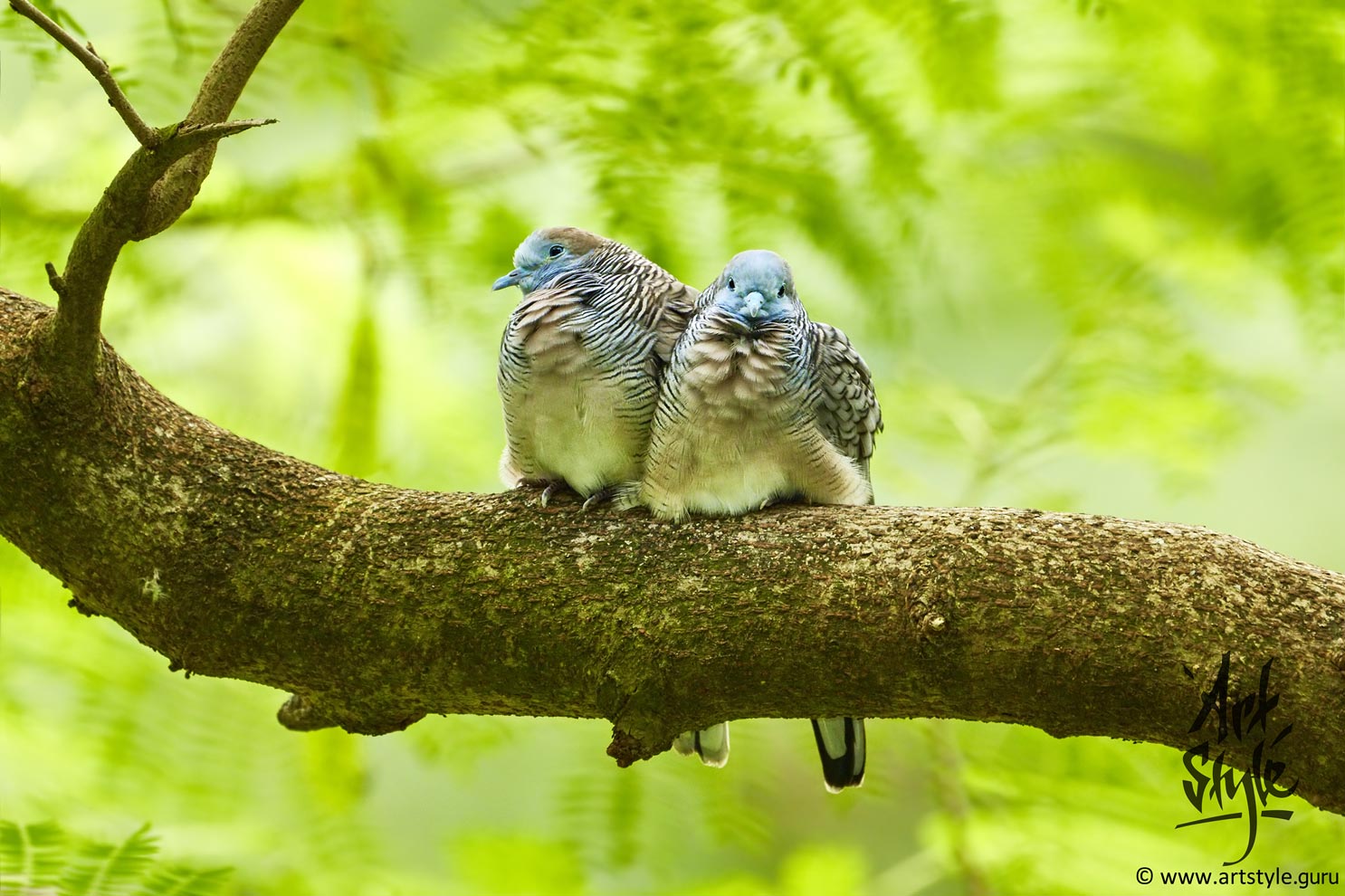
Zebra Doves, a couple
Canon EOS 5D Mark III + EF 100-400/4.5-5.6 L IS II + 1.4 ext III · 560 mm · f/8 · 1/80 s · ISO 1250
In Thailand and Indonesia, zebra doves are kept as songbirds, with cooing contests held to crown the finest voice.
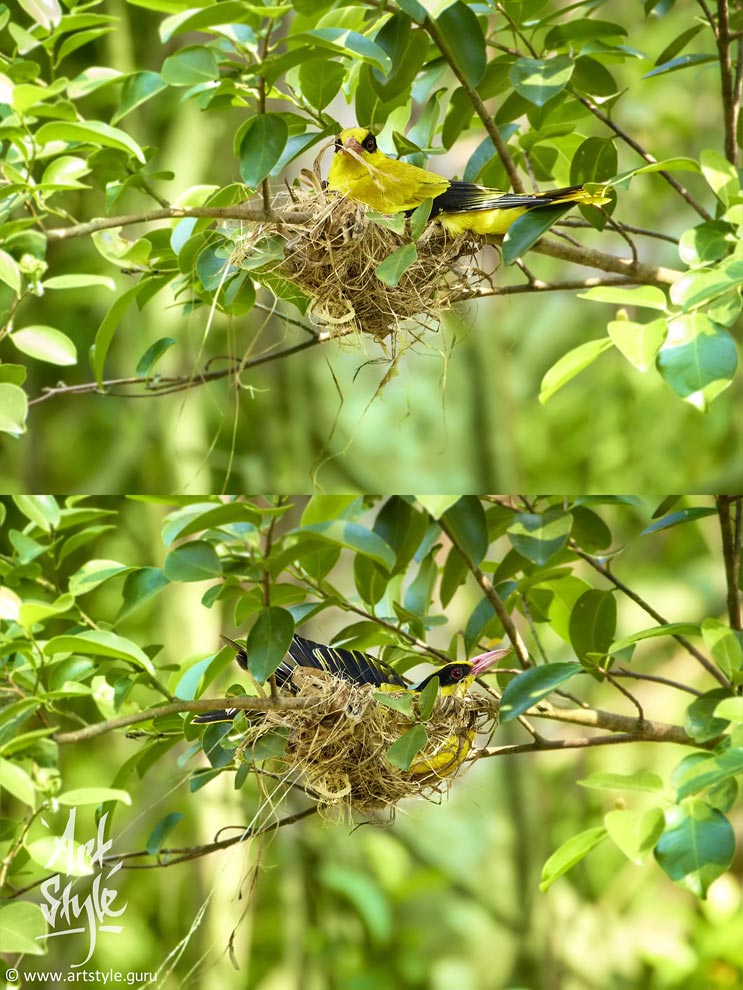
Black-naped Oriole
Canon EOS M3 + EF 100-400/4.5-5.6 L IS II + 1.4 ext III · 560 mm · f/8 · 1/160 s · ISO 800
An oriole's nest-building algorithm is simple: 1) drag over a couple of blades of grass, 2) try it on for size. Their breeding season starts in April, but, like proper businesswomen, they won't begin until they've built themselves a home. And orioles are well-to-do businesswomen at that: they'll usually put up two or three nests at once and then choose whichever they like best. The male's role is no less honourable: 1) make the babies, 2) move into one of the wife's vacant nests.

Violet Turaco
Canon EOS 5D Mark III + EF 100-400/4.5-5.6 L IS II · 400 mm · f/5.6 · 1/100 s · ISO 1250
The turaco's feathers are so vividly coloured that their pigment dissolves in water — the water turns red, while the bathing bird itself takes on an emerald sheen. To an inexperienced naturalist it leaves the firm impression that someone has painted the bird on purpose, as a prank. The turaco also had its moment as one of the prototype images for Avatar — though, under some unknown substances in James Cameron's head, the blue bird became the blood-red predator Toruk Makto (the red water from a bathing turaco must have made quite an impression).

Eurasian Hoopoe
Canon EOS M3 + EF 100-400/4.5-5.6 L IS II + 1.4 ext III · 560 mm · f/8 · 1/125 s · ISO 800
And here I managed to photograph, in Thailand, the Jewish bird of happiness — so happy, in fact, that it's become a national symbol of Israel. The hoopoe guards its nest in a distinctive way: in season, the adults and chicks secrete an oily, sharp-smelling liquid from the preen gland and let fly with it, droppings and all, at any uninvited guest. How effective this is against small predators I couldn't say, but that it's insulting is beyond doubt.

Asian Fairy-bluebird, female
Canon EOS 5D Mark III + EF 100-400/4.5-5.6 L IS II + 1.4 ext III · 560 mm · f/8 · 1/80 s · ISO 640
A rare case in nature where the female is lovelier than the male. Among people this tends to happen when, say, the husband works at a factory and is overfond of cheap fruit wine. And as befits a couple where both are good-looking, these birds will now and then live as a ménage of six to eight — which, among humans, is most common when the spouses are good-looking creative types. The young males, incidentally, resemble the females in colour, which likens them to those same creative sorts once again.

Asian Fairy-bluebird, male
Canon EOS 5D Mark III + EF 100-400/4.5-5.6 L IS II + 1.4 ext III · 560 mm · f/8 · 1/125 s · ISO 1600
At first glance you might take it for a Thai crow in drag, but no. The young eat anything going — from beetles and spiders to fruit and nectar; the adults, however, turn committed vegetarians, earning karma points, enlightenment and brilliant plumage for it. And that this is a sexually mature male is clear at once — from the unmissable… that's right, the colour of the feathers.